Habari means "message" or "What's up?" in Swahili. If you've missed our last newsletters, simply... HERE click. You can also HERE Sign up for future newsletters.
In the cover photo: Lisa with her Sports Friends group in the Kariobangi slum – before Corona!
Our vision:
Making more effective health services possible in East Africa.
HERE You can learn more about our work.
Hello from Kenya!
The world has turned upside down! Within a very short time, a virus has spread across the globe, holding people and economic systems firmly in its grip. How many people are probably feeling lonely or gripped by worry right now? Worried about their loved ones, their jobs, their own health? We are in an exceptional situation that demands a great deal of adaptability and trust. We want to send you all our strength, patience, creativity, and hope from afar!
The current situation and the emotions it evokes present an unprecedented challenge for most people in the West, but for almost everyone in the poorer parts of the world, this is sadly nothing new; it's simply part of everyday life. The fear of a potentially fatal case of pneumonia or influenza is a normal reality for over 100 million people in East Africa because medical care is unavailable or unaffordable. While hospital treatment can help overcome illnesses or injuries, the high costs often mean financial ruin for the patient's extended family. This is, unfortunately, a tragic reality here.
We would like to invite you to briefly reflect on your feelings of insecurity in all their aspects and imagine it as your everyday reality. We hope that this situation will foster greater empathy between the "first world" and "developing countries.".
What is the impact of the coronavirus in Kenya?
After a long period of silence from the government, the announcement came three Sundays ago: "All schools will be closed starting tomorrow." Our children were thus rather abruptly thrust into virtual learning, which is currently quite time-consuming. Some of our friends and teachers have flown back to their home countries. Having to say goodbye to dear friends unexpectedly and for an indefinite period has left a void in our lives. Following the school closures came the suspension of air traffic, various physical distancing and hygiene regulations, as well as nighttime curfews and restrictions on movement.

The biggest problem is that most people here will have nothing to eat tomorrow if everything comes to a standstill. We're talking about 901,300 people who have no savings and therefore live hand to mouth. How are they supposed to just stay home for a few weeks and do nothing? The government's response to a health problem, intended primarily to protect the elderly and those with pre-existing conditions, has suddenly become a fight for survival for perfectly healthy people – a great many people! In many poorer parts of the country – especially in the slums – there's a tense atmosphere, but almost everyone is making a real effort.
However, it is often impossible to comply with simple regulations, such as washing hands, because the water, delivered in yellow jerrycans on handcarts, is becoming increasingly expensive. Social distancing is also very difficult in these densely populated neighborhoods and simply impossible in one-room shacks shared by multiple generations. We hear of sick family members simply being abandoned in empty houses. Food parcels are being distributed and handwashing stations set up, but raising awareness is also crucial to counteract the many "fake news" stories.
On the home front
For us as a family, this whole situation means nothing but inconvenience compared to others. Since there are no longer any normal international flights, some of our foreign friends, colleagues, and even teachers have decided to fly home early. Saying goodbye unprepared leaves a certain emptiness for us, especially for the children. After much deliberation, we've decided to stay here – not lightly. Whether we'll be able to fly in the summer is uncertain.
The children now have to complete their school day at home. This is not only a significant adjustment for them, but also a challenge for the whole family.

David feels affirmed in the importance of his work in this situation. The weaknesses in the healthcare system are currently being exposed to everyone, and BANDA Health is part of the solution. He remains in contact with the clinics via video conference and is able to work well from home. He is pleased that he is now spared the many hours spent commuting. However, communication with the locals is very difficult because the nonverbal cues, which play an important role in this culture, are not conveyed. In addition, poor internet connections and power outages further complicate communication.
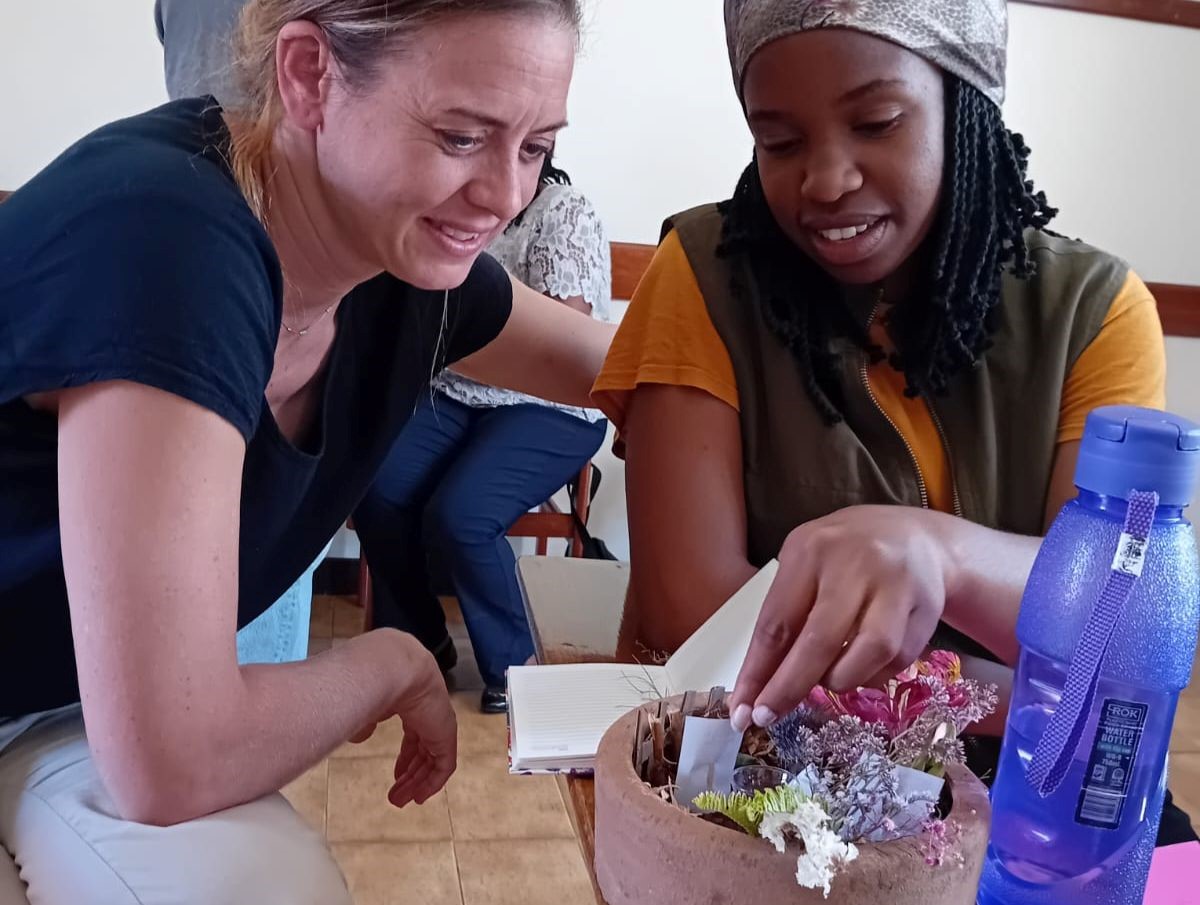
Unfortunately, Lisa had to break off physical contact with the two groups of women. This pains her because friendship and trust had only just begun to develop. However, we hope to be able to offer more support at the Ngando Community Center. The dedication with which the people there provide neighborly assistance is truly inspiring! Here are a few pictures:


Tazama Nia
In our last letter, we told you about a "trauma processing course" that Lisa is offering in collaboration with a community center in Ngando. Sixteen women attended the first meeting, where topics such as "What is trauma?", "What does God say about emotions?", and "The path from injury to resilience" were discussed. Working in tandem with Caro, a Kenyan teacher who knows all the women well from the English course, was a real pleasure – Lisa presented the content, and Caro bridged the cultural gap with important additions.

Tazama nia (which translates to "looking forward to the future with anticipation") is the name of the aforementioned community center, where many women and children come and go. Our friends, who run this center and live alongside the people there daily, want to be there holistically for the most vulnerable. They offer help for children, the illiterate, and those struggling with alcoholism. During our last camping weekend, Brad, the center's founder, told us about their vision of becoming a part of these people's stories (more information on their website). websiteIf this work sparks your interest, perhaps an internship there would be something for you? They are always looking for interns for 3-6 months.

and otherwise…
What the media often forgets is that other problems don't take a break because of Covid-19. In Europe, the annual flu season is slowly coming to an end, but cancer continues unabated. In America, 70,000 people still die each year from drug overdoses and 50,000 from suicide. Here, typhoid, malaria, and gastritis have a firm grip on the population. Terrorists and private investors are wreaking havoc, exacerbating the pervasive poverty even further, as if nothing else were amiss. But we focus on what we can influence right now.
In summary, we are relatively well off, and if we try to bring all these things before our Almighty Lord in prayer, then we will find God's peace in stormy times. As it says in the Bible in the Letter to the Philippians, chapter 4:

Thanks for…
Health
family and friends
Protection from accidents and attacks
Lisa's trauma group
The heroes in the small clinics who give their best for their patients
Fully functional new car
Pray for…
Harmony during lockdown (homeschooling)
Layla has been having frequent nightmares and anxiety lately.
That the slums remain untouched by Corona
Protection (diseases/injury)
It is also encouraging that Queen Helen (Do you remember the last letter?) With your help, she was able to pay the school fees for all her children! THANK YOU! That makes giving truly rewarding!
Thank you all for maintaining your positive attitude in times like these and for not ceasing to encourage one another and wait for the Lord! Recently, a child said, "I think Jesus is coming soon." We hope that when the Lord comes, this event will not catch us by surprise, as our global fragility has.
We wish you God's peace and blessing, and that you may realize in these times how you can be part of the solution.
the miners