Hello from Kenya,
Some time has passed since we last wrote, but we were able to see many of you during our summer stay at home.
Regulation stations, pastoral care seminars & soul care groups
When I go to the Kenyan school (CPAWhen I arrive, the children smile at me warmly and say, "Aunty Lisa, are you coming for the peace corner?" Last semester, I worked intensively with about 10 primary school teachers on a concept for promoting emotion regulation in the classroom. The result is so-called "regulation stations" that give students space to regulate themselves when they are in the "red" or "blue zone," thus supporting the transition from a "fear brain" to a "learning brain.".

A fifth-grade girl who is currently using the regulation station
Preparations for further pastoral care seminars are already in full swing. This time, we will also be offering a seminar for women on the coast as well as special training for pastors. This week we had our first team meeting for the next pastoral care retreat! It's noticeable that we are much more cohesive as a team this year, as we know and trust each other and enjoy a wonderful sense of community. I recently spoke with a pastor from the neighboring town who said, "So many people come to me with their problems, and often I don't have a good answer ready. Many pastors have lost their credibility because they look the other way or respond with overly spiritual platitudes."„


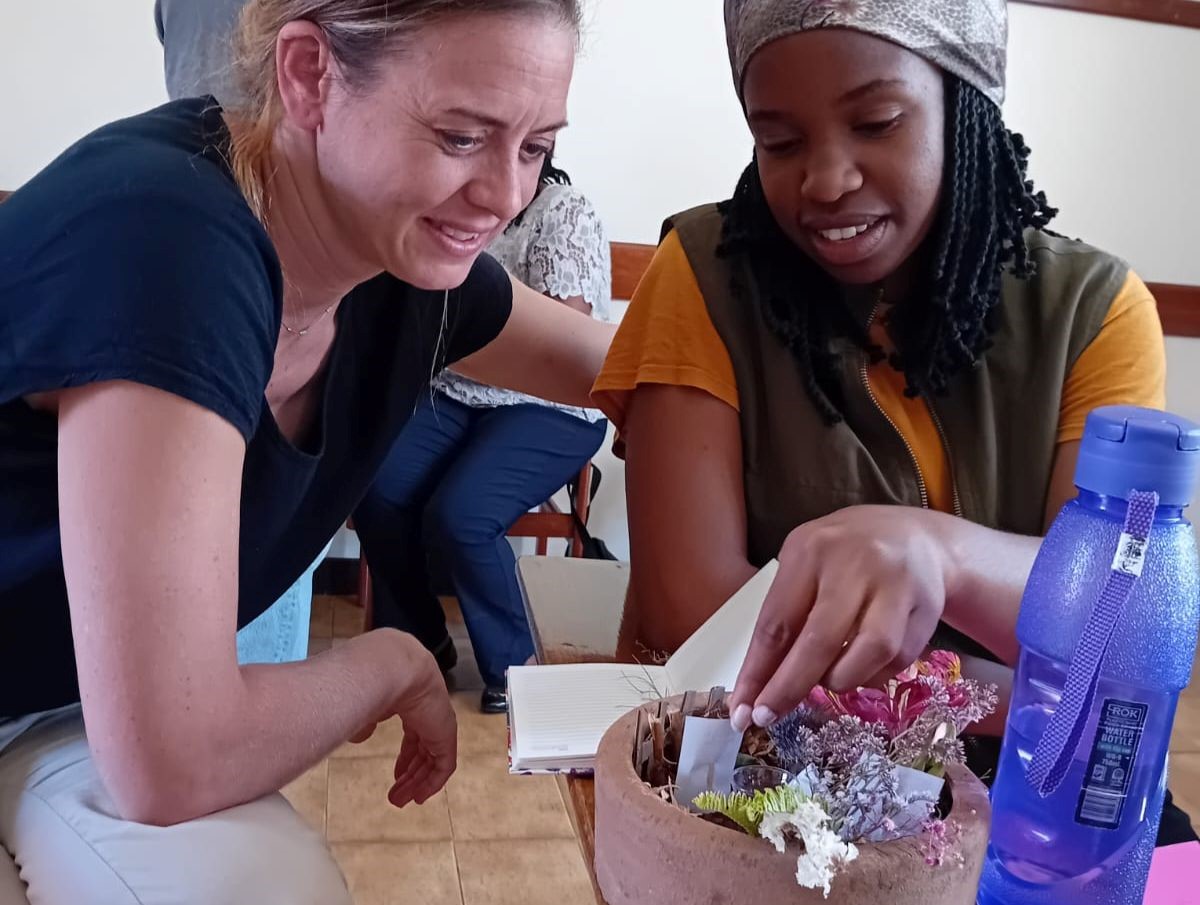
A kind of women's group has emerged from a pastoral care seminar.
My vision is to create more spaces where people can support and encourage each other to grow into their potential. To let go of what holds them back and embrace what sets them free., This is an important process. In recent months, a Soul Care group has formed here in Kijabe, and I am amazed by the honesty of these women.
I also meet regularly with a few of them for mentoring. Sometimes we go for a "walk and talk" together, sometimes the story cubes help to better understand family dynamics.
The cost for participation in the pastoral care days is approximately €100. Would you like to contribute financially? See the bank transfer information at the bottom.


Left: My girlfriend with whom I have a one-on-one relationship / Right: Alternative methods for processing stories and experiences
Banda Health
Our team has grown again after a difficult period, and we feel more productive. The number of clinics—and therefore patient visits—that we support continues to rise. The government is currently making many changes to the healthcare system, some of which are truly necessary and positive, others incomprehensible. This is causing us problems for two reasons: firstly, the Ministry of Health owes clinics and hospitals an average of six to nine months of compensation payments (meaning they are left to shoulder all the costs); secondly, many processes (which, after much effort, are finally working well) have to be adapted to the new structures.


Left: Clinic in Maasailand / Right: Laboratory equipment being discussed with a partner
Currently, I (David) am increasingly enjoying "road trips" across the country with a partner who wants to equip remote clinics with handy mobile ultrasound devices (which plug into a mobile phone and are AI-supported) and establish training and telemedicine partnerships. This gives clinical officers who have never analyzed an ultrasound image before access to previously unimaginable diagnostic possibilities on-site. It's incredibly exciting to see their eyes light up when my digested lunch is clearly visible on the screen (I'm usually their training dummy) 😊. They're then brimming with ideas and possibilities for what they can now diagnose more effectively.
Side projects
Besides our two main occupations (Lisa – trauma counseling, David – Banda Health), we have been involved (with your help) in many smaller aid activities in recent years. Some have asked, Here's a brief overview of the progress:

Mumbi's House – the house is finished, paid off, and has been the home of our housekeeper Mumbi, her husband, and four children for two years.n. But they still have to fetch water from the stream during the dry season (when the rainwater runs out), and for electricity they use our camping system (10-watt solar panels and a small battery for lights and charging their cell phone). Mumbi is so proud of it. Here's a thank-you video from her daughter to "the people in Europe." In it, she describes how her life has changed since Mumbi found stable employment.
You can find the translation in the video description.
village bakery Things aren't going so well right now because most people can't afford bread, cakes, and similar items due to the current inflation crisis. On top of that, there's more crime; all the neighboring shops have been robbed in recent weeks and have had to close (when it rains heavily, the corrugated iron roofs are so noisy that you can't hear anything)., how they break in). The bakery's locks are damaged, but the robbers didn't manage to get in this time.

Water projects During the last dry season, the well in Njihia's yard was the only water source for many farms in the valley below Kijabe. Benson's rainwater tank supplied all his neighbors in Kabete for three months, but eventually, its 15,000 liters ran out. Now that it's finally raining again, his tank is full.


Financial advice David regularly offers financial advice to families in the area. From the very beginning, it quickly became clear that most people lacked an overview of their income and expenses. To help with this documentation, David developed an app that allows people to easily record all their family transactions and create savings plans. The pilot phase is now complete, and we are about to launch the app.

First aid training Motivated young people receive weeks of first aid training and basic equipment. This project is still in its early stages and may not be continued, as the government is currently launching a similar project. We will observe the success of the government project and learn from it. 😊

School fee assistance Unfortunately, it often happens that children have to drop out of school because their families can't afford the fees. Since our arrival in Kijabe, your donations have helped over 80 children in difficult situations to stay in school. Some of you have even pledged to help children in truly hopeless situations with their school fees until they graduate. This is not only generous and compassionate, but also a sound investment in the future.

If you would like to support these side projects, please add the word "Side Projects" to the payment reference (for Austria: "Miner Family - Side Projects". For Germany and Switzerland, please contact us directly).
THANKFUL:
- For rain! Fruit and vegetables are finally growing again!
- Two „Soul Care“ small groups emerged from the seminars in May.
- David's brother, Mix with family is now also nearby (and perhaps even teaches our girls at the RVA)
HOPEFUL:
- That the right people register (in time 😊) for the pastoral care seminars in February and that the team grows even closer together.
- Parts of the country have been inaccessible for weeks due to flooding; a humanitarian catastrophe looms on the horizon.
- Crime increases significantly before Christmas. Some friends fear burglaries, etc.
Here are a few more impressions from our last few months:


Left: Lisa has David visit a clinic on the coast in the town Lamu accompanied. This naturally includes a fishing trip in a traditional dhow / Right: Layla with her basketball team at a school tournament.


Left: Noemi helped with our lectures for the first time during her home visit / Right: A sunset walk in Kijabe.


Left: Brother-in-law Berndi from Malawi was in Kenya and found time for a mountain bike ride / Right: A visit to Diguna

colleagues from our sending organization Hilfe die ankommt They visited us in Kenya, here in a small clinic on the outskirts of Nairobi.
We wish you a blessed Christmas. Warm greetings from Kijabe,
The Miners
Lisa, David with Noemi and Layla